Local Rules
01Zoning, building code, and jurisdiction requirements.
The Development Operating System for the Built World.
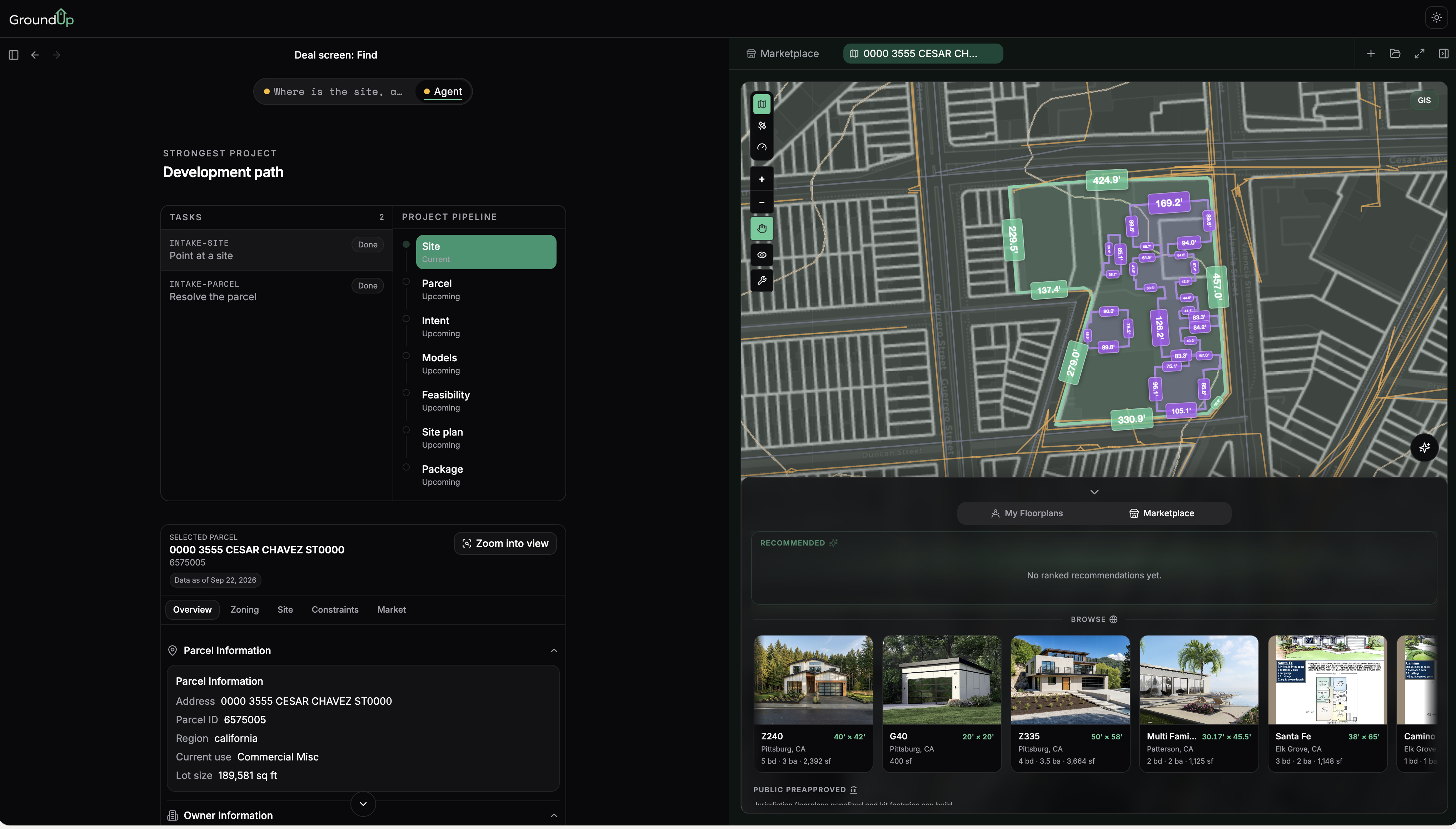
GroundUp combines Local Rules, Site, Market & Economics, and Factory constraints into one computable project model—then tests viable scenarios to optimize yield, returns, factory fit, and execution against your stated goals and known constraints.
Conceptual scenarios keep assumptions, unresolved questions, and professional verification requirements visible.

One computable model
Local Rules · Site · Market & Economics · Factory
The GroundUp model
A development only works when four systems work at the same time.
Zoning, building code, and jurisdiction requirements.
Geometry, topography, utilities, access, and physical site constraints.
Demand, absorption, costs, development assumptions, and target returns.
Products, plant capabilities, service regions, logistics, pricing, and production constraints.
Scenario testing
GroundUp tests viable combinations of site layout, density, product, factory, and project assumptions against the developer’s goals.
Compare unit count, model mix, orientation, building system, manufacturer, economics, and execution trade-offs without presenting assumptions as approvals.

Primary outputs
See the project from four decision-critical angles before the selected scenario is packaged for handoff.
How much can fit and how the project can be configured.
Which products and manufacturers can realistically execute the project.
How each scenario performs against cost and return targets.
What is known, assumed, unresolved, or still requires professional verification.
The output
GroundUp is the engine. The Development Project Package is the output.
The selected scenario becomes a versioned Development Project Package containing the site evidence, conceptual plan, yield, preliminary economics, factory fit, assumptions, risks, and next actions needed to move the project forward.
See the Project Package
Sources, timestamps, jurisdiction and site conditions, and verification status.
Conceptual plan, yield, product mix, and the assumptions that produced it.
Preliminary performance, compatible systems, logistics, and open confirmations.
Material risks, unresolved items, owners, versions, and next actions.
Evidence and trust
Material conclusions retain their source, timestamp, assumptions, confidence, status, version, unresolved questions, and professional verification requirements.
The four systems that determine a project often speak different languages. GroundUp converts them into one computable development model.


Keep evidence, scenarios, decisions, and changes in one retained project context.
Project-to-factory compatibility
GroundUp connects what a project needs with what a factory can actually execute.
Developer inputs
Site, buy box, geography, program, yield objectives, economics, return targets, timing, and strategy.
For developersGroundUp
Project-to-factory compatibility
Manufacturer inputs
Products, plants, building systems, dimensions, service regions, logistics, lead times, pricing, and production constraints.
For manufacturersFrom the GroundUp journal
A founder-written point of view on the digital infrastructure housing delivery still needs.
Jul 13, 2026 · 5 min read
Housing delivery depends on connecting land, rules, products, manufacturers, and decisions—not adding another disconnected database.
Read the articleFounder-led
Book time directly with GroundUp’s founders to review a site, buy box, active project, or development goal.
Book a Demo